

Off-Grid Inverters Enable Direct PV-to-Load Powering Without Energy Storage for Remote Areas
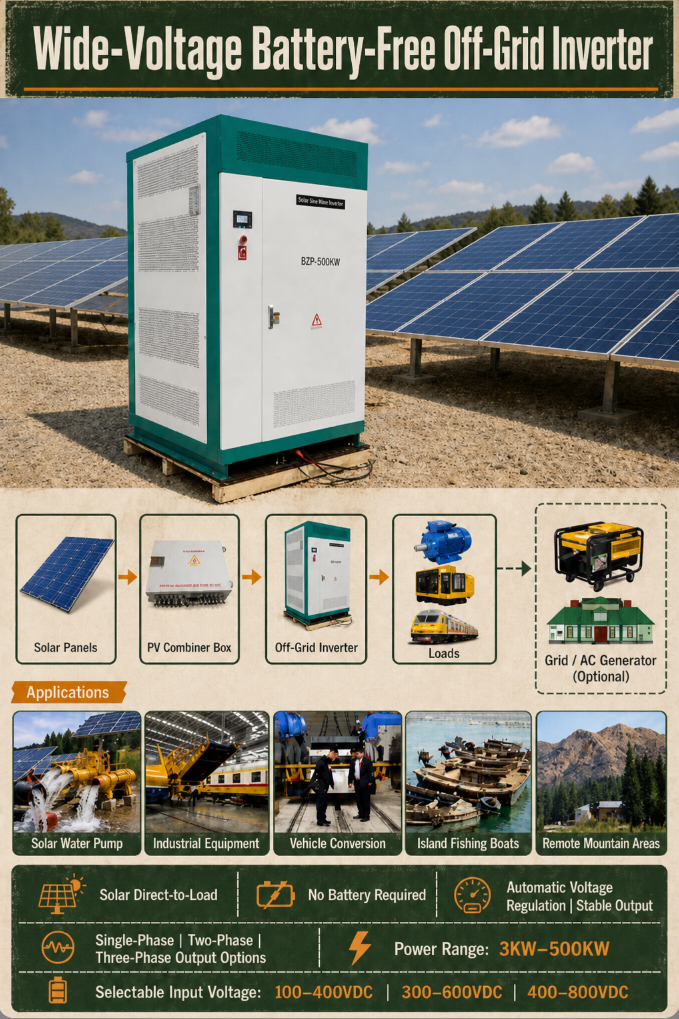
Traditional off-grid PV systems typically require battery storage to store and release energy when sunlight is insufficient. However, batteries entail additional costs for procurement, installation, maintenance, and replacement. Furthermore, in environments characterized by high temperatures, remote locations, or difficult transport access, ongoing maintenance can become a significant operational challenge.
In contrast, battery-free, direct-drive off-grid inverters operate without a battery connection, converting DC power generated by PV modules directly into AC power for the load. By incorporating wide-voltage MPPT (Maximum Power Point Tracking) capabilities, the system maximizes the utilization of solar energy resources and reduces reliance on traditional energy storage components.
According to product specifications, this series of inverters offers selectable wide-voltage input ranges—such as 100–400V, 200–500V, or 400–800V—allowing configurations to be tailored to the specific PV module array (series/parallel connections) and actual load requirements.
II. Pure sine wave output: Compatible with a wide range of electrical equipment
For equipment such as electric motors, water pumps, compressors, air conditioners, and other inductive loads, the quality of the power waveform directly impacts startup performance, operational stability, and service life. This series of off-grid inverters features a pure sine wave output with less than 5% total harmonic distortion (THD), providing stable power for various types of AC loads.
Applicable equipment includes:
Various power tools;
Electric motors and water pumps;
Fans, air conditioners, and compressors;
Household appliances such as refrigerators and washing machines;
Lathes and other industrial equipment;
Lighting, control, and production equipment for off-grid applications.
With its stable AC output, the inverter enables users to establish flexible, independent power supply systems in environments lacking access to the public grid.
III. Power-frequency isolation design enhances system safety and stability
Off-grid power supply in complex environments places high demands on electrical isolation, interference resistance, and long-term operational stability. This product utilizes a power-frequency isolation transformer design, fully isolating the AC and DC buses; this minimizes mutual interference between AC and DC circuits, thereby enhancing system safety and stability.
Additionally, the product employs a high-efficiency IPM (Intelligent Power Module) and includes protections against short circuits, overloads, and over-temperature conditions. In the event of abnormal operating conditions, the protection mechanism responds promptly, providing multi-layered safety assurance for both the inverter and the connected loads. Product specifications indicate a service life exceeding 15 years, making it suitable for applications requiring continuous operation and high equipment durability.
IV. Dual-mode startup to meet diverse load requirements
Startup characteristics vary across different types of loads. While standard equipment typically exhibits relatively smooth power fluctuations during startup, inductive loads—such as motors, water pumps, and compressors—can generate significant inrush currents at the moment of startup.
To address this, the inverter features a dual-mode startup function, allowing users to select either reduced-voltage startup or variable-frequency startup via the LCD screen. Selecting the appropriate startup mode based on the specific load type enables optimal matching of inverter capacity; this avoids the unnecessary over-specification of equipment, thereby reducing system configuration costs.
Furthermore, the output frequency can be adjusted as needed—for instance, setting the motor control frequency to 30Hz allows the inverter to output the corresponding frequency to meet the specific operational requirements of the load. V. Flexible Input Voltage Adjustment to Expand PV Application Scope
In systems without energy storage, PV input is inherently volatile, heavily influenced by sunlight intensity, weather fluctuations, and the operating status of the modules. This product supports adjustable input voltage ranges; parameters such as undervoltage/overvoltage thresholds and their respective recovery points can be configured via the LCD screen.
This feature enables users to flexibly adjust system input parameters based on the specific PV module configuration and actual sunlight conditions. It ensures superior system adaptability when changes occur in the number of series-connected PV modules, operating voltages, or on-site operating conditions.
The LCD screen provides real-time display of input DC voltage, output frequency, phase voltage, phase current, grid bypass voltage, energy output, operating time, and fault information, facilitating equipment status monitoring and routine maintenance.
VI. High-Efficiency Conversion to Minimize PV Energy Loss
In off-grid power generation systems, inverter conversion efficiency directly impacts the utilization of PV energy. This product employs SVPWM (Space Vector Pulse Width Modulation) technology combined with a design optimized for high-frequency power handling and low-voltage load conversion; specifications indicate a conversion efficiency exceeding 93%.
High conversion efficiency helps minimize energy loss during the conversion process, allowing a greater share of PV-generated electricity to power actual loads. For applications characterized by limited solar resources, extended load operation times, or constrained system capacity, this high efficiency further enhances overall power supply performance.
VII. Compatibility with Diverse DC Inputs to Meet Varied Energy Mix Requirements
In addition to PV modules, this series of off-grid inverters is compatible with a wide range of DC input sources, including:
Fuel cells;
Lithium batteries;
Lithium iron phosphate (LiFePO4) batteries;
Gel batteries;
Lead-acid batteries;
Rectified inputs from wind turbines;
Rectified inputs from hydro-turbine units.
While the product supports battery integration, a core application scenario involves direct PV-to-load operation without the need for batteries. Users can choose a pure PV direct-supply mode based on project requirements or combine the inverter with other DC energy sources to construct a more flexible off-grid power supply system. VIII. Suitable for Various Off-Grid and Weak-Grid Scenarios
Featuring no energy storage requirement, direct PV power supply, pure sine wave output, line-frequency isolation, and multiple protection mechanisms, this product is particularly well-suited for the following applications:
Electricity for production and daily living in remote mountainous areas;
Independent power supply for pastoral and border defense regions;
Off-grid facilities on islands and coastal areas;
PV water pumping and agricultural irrigation systems;
Power for outdoor engineering projects and temporary operations;
Power supply for telecommunications, surveillance, and remote equipment;
Multi-energy complementary systems integrating wind, hydro, and solar power.
For users lacking a stable public grid who also wish to minimize investment in energy storage batteries, this storage-free, off-grid inverter—capable of directly powering loads via PV—offers a new technical solution for independent power supply systems.
Zhejiang Bangzhao Electric Co.,Ltd.
Zhejiang Bangzhao Electric Co.,Ltd.
Legal Disclaimer:
EIN Presswire provides this news content "as is" without warranty of any kind. We do not accept any responsibility or liability for the accuracy, content, images, videos, licenses, completeness, legality, or reliability of the information contained in this article. If you have any complaints or copyright issues related to this article, kindly contact the author above.
